

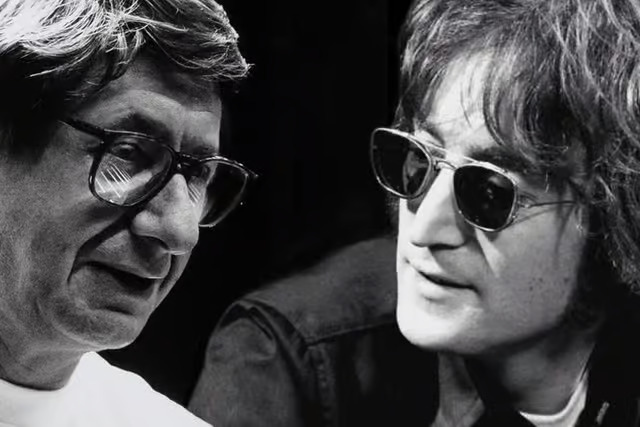
On a cold Thursday night, I had a phone call with Tony Palmer, who is one of the most interesting people I have had the pleasure of meeting.
We were speaking with the intention of talking about Leonard Cohen, but he was not the only famous musician with whom Palmer shared a friendship.
Tony Palmer has made his name as one of the most acclaimed music documentary-makers in history and has the awards to prove it.
Palmer’s career has been marked by encounters with some of the biggest names in rock history, including Pink Floyd, Frank Zappa, Jimi Hendrix, Cream, Rory Gallagher and John Lennon.
In this article, I have allowed Palmer to tell the story of his first meeting with his close friend, John Lennon, in his own words.
“He was, for quite some period, one of my best friends.
“He wrote a dedication to one of my books. He was one of my best friends, I mean, for a period from about 1963 when I first met him.
“I mean, the story of how I met him is really bizarre.”
At the time of their meeting, Palmer was studying Moral Sciences at the University of Cambridge.
“I was at university at Cambridge.
“The Beatles came to give a concert at the old Regal Cinema.
“They were then famous.
“They’d had a couple of number ones, but they weren’t intergalactic, as they became.”

“I was sent by the university newspaper to attend a press conference that The Beatles were giving.
“Afterwards, we were all standing around and Lennon came up and tapped me on the shoulder and said: ‘Why did you not ask any questions?’”
Palmer responded to the Beatle: “Well, because honestly, I thought the whole thing was pretty silly,”,a notion with which Lennon agreed.
He asked: “And what do you do?”
When Palmer told him he was a student, Lennon replied: “What of?”
Palmer told him he was studying Moral Sciences.
He thought that was pretty silly. So he said, “Well, would you show me around the university that afternoon before the concert in the evening?”
He thought the university was one place as opposed to lots of little colleges in Cambridge.
Palmer originally rejected Lennon’s idea.
He said: “I said no, because I thought you’d been mobbed, and that wasn’t my idea of fun.”
“So he said: ‘Well, how about if I come in disguise?’”
“My bluff had been called.”
Palmer and Lennon agreed to meet, and Palmer went to pick up Lennon at 2pm.
“So I went to pick him up at about 2pm and was met by this apparition.
“He’d somehow found this ridiculous false beard, and he was wearing an enormous fedora hat.
“As well, he was wearing, without doubt, the dirtiest Macintosh I think I’ve ever seen.”
“So we both got the giggles and anyway got rid of his disguise and I managed to get him into a couple of things.”

He added: “At the end, I said: ‘You’ve got to go and do a concert this evening,’ sort of making a joke of it.
Then, he scribbled a phone number on a piece of paper and said: “Call me when you come to London, and let’s talk some more.”
The two did not speak again for several years until the mid-1960s, when Palmer was working for the BBC, a role for which he became well known.
He said: “Three years later, The Beatles were absolutely intergalactic, but I still had this bit of paper.
“I thought, well, l’d call the telephone number”
At the time, Palmer did not believe that the number was still active, and was surprised when someone did answer.
He said: “Anyway, to my surprise, somebody did answer.
“You could tell from the tone of this poor girl’s voice that I was the 400th person who’d rung up that morning saying ‘John Lennon said to call.’”
Palmer replied: “Well, he did,” and gave the girl his phone number, not expecting a call back.
However, to his surprise, someone did respond
He said: “About half an hour later, a guy called Derek Taylor called me.”
Derek Taylor was The Beatles’ long-time publicity manager.
He said, “I’ve got a message for you from John.”
“I thought ‘Oh God, what is his message?’
“I eventually said: ‘Well, what is the message?’”
The message was: “John wants to know why it took you three years to call him back.”
From there, Palmer and Lennon had a long conversation and began the close friendship that would last for years.
Palmer and Lennon remained friends throughout the 1960s and 1970s.
Lennon helped Palmer with his 1976 documentary All You Need Is Love and contacted many of the rock stars who appeared in it.
They remained friends until Lennon’s assasination in December 1980.
Palmer has kept numerous private telegrams from Lennon, which he will never release because of their personal significance.

