

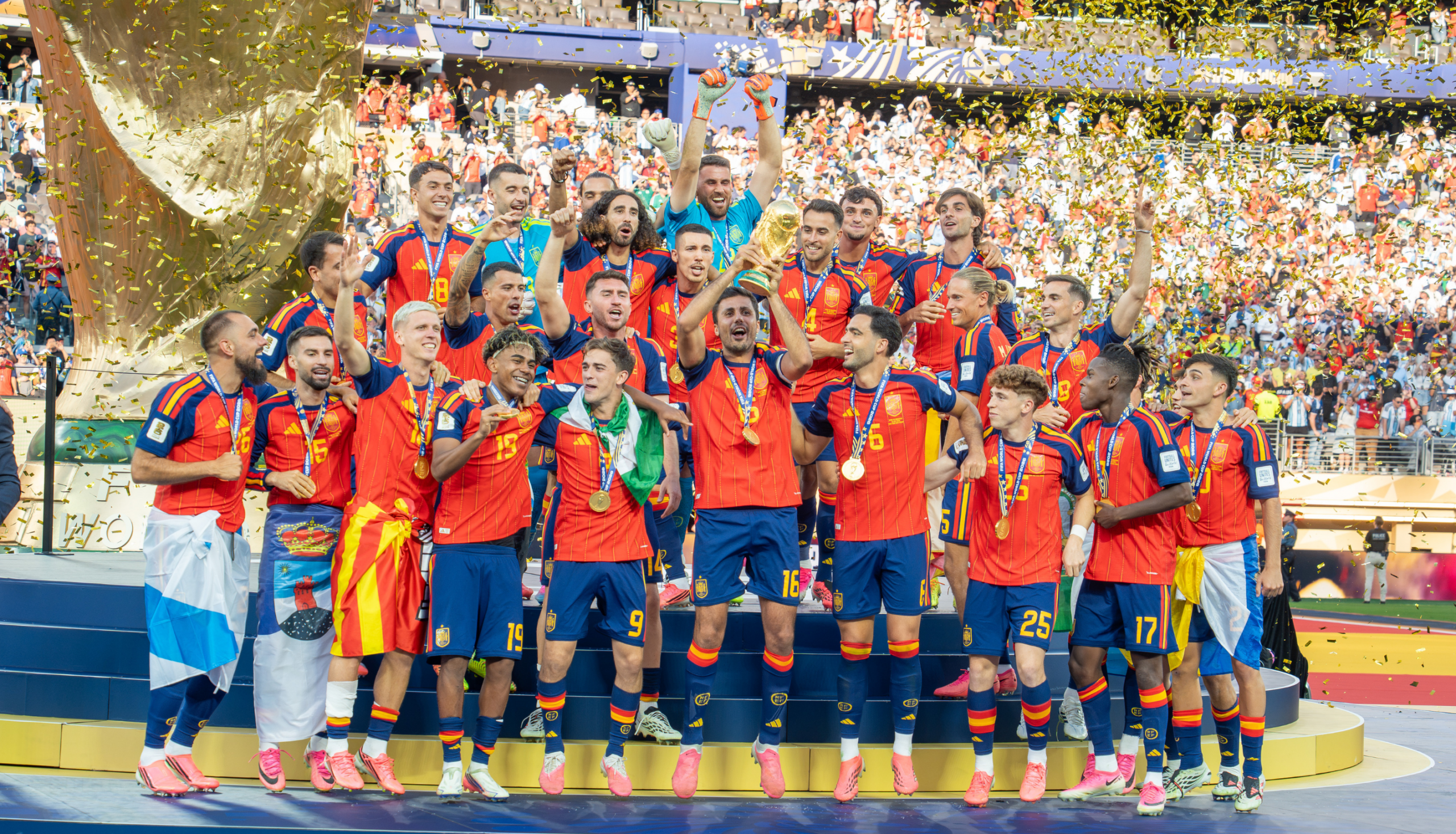
Sixteen years after they first conquered the footballing world in South Africa, Spain are world champions once again.
On a humid evening at MetLife Stadium in New Jersey, La Roja defeated Argentina 1-0 after extra time to lift their second FIFA World Cup trophy, bringing the curtain down on five unforgettable weeks across the United States, Canada, and Mexico. In front of more than 80,000 spectators and millions watching around the world, Ferran Torres etched his name into Spanish football history, scoring the decisive goal that separated two of the world’s finest teams after 120 gruelling minutes.
Spain dominated possession for long spells, patiently probing for an opening against a resilient Argentina side determined to retain the trophy they won in Qatar four years ago. Lionel Messi, playing what could be his final World Cup match, barely produced flashes of the brilliance that has defined his career, giving Spain’s disciplined defence the chance to refuse him the space to produce one last magical moment.
As extra time wore on, it seemed penalties would decide football’s greatest prize. Then came the breakthrough. Torres found himself in the right place at the right time, calmly converting the chance that ultimately secured Spain’s place back on top of world football. Argentina threw everything forward during the closing stages, but Spain stood firm before celebrations erupted at the final whistle.
For Luis de la Fuente’s side, it was the perfect ending to a remarkable campaign. Their blend of experienced leaders and fearless young stars has delivered another golden era for Spanish football, with players such as Lamine Yamal, Rodri, and Torres demonstrating exactly why many believe this team can dominate international football for years to come.
Yet while Spain deservedly leave North America as world champions, the story of the 2026 World Cup stretches far beyond the team lifting the trophy, as ironically, Spain’s title-winning journey almost began with one of the biggest shocks in World Cup history.
Tournament debutants Cape Verde held the European champions to a goalless draw in Atlanta on match day one, leaving many wondering whether Spain had underestimated their opponents. Instead of derailing their campaign, however, the result appeared to galvanise them.
From that point onwards, Spain looked every inch a champion.
They swept aside Austria in the Round of 32 before edging Portugal in an emotional Iberian derby. Belgium were next to fall in the quarter-finals before Spain produced arguably their finest performance by defeating France to reach the final.
Throughout the knockout stages, Spain combined technical quality with remarkable defensive resilience. Rodri controlled the tempo in midfield, Yamal continued to establish himself as one of football’s brightest young stars, while Torres consistently delivered when his country needed him most.
The reward was a second star above the Spanish crest and confirmation that another golden generation has arrived.
Although the trophy slipped from their grasp, Argentina once again reminded the footballing world why they remain among the sport’s elite.
Lionel Messi inspired another remarkable run to the final, producing moments of brilliance that captivated supporters throughout the tournament. Argentina survived one of the competition’s most entertaining knockout ties by overcoming Cape Verde in a dramatic 3-2 thriller before dispatching Switzerland in the quarter-finals.
Their semi-final against England provided another classic. In a fiercely contested encounter, Argentina found the decisive moments to book another World Cup final, keeping alive hopes of retaining their crown.
Ultimately, Spain proved one step too far.
While defeat was undoubtedly heartbreaking, Argentina leave the tournament with enormous pride after once again reaching football’s biggest occasion.
Another nation, that captured the imagination of neutral supporters, was Cape Verde.
Making their first-ever appearance on football’s biggest stage, few expected the Blue Sharks to trouble Europe’s elite. Instead, they announced themselves immediately by frustrating eventual champions Spain in a goalless draw that stunned the football world.
It was only the beginning.
Fearless in possession and organised without the ball, Cape Verde refused to play with the caution many expected from tournament newcomers. Their passionate travelling support quickly became one of the defining images of the competition, while their players embraced every occasion with confidence and belief.
Their Round of 32 clash with Argentina summed up their tournament perfectly.
Although they eventually lost 3-2, Cape Verde pushed the defending champions until the very final whistle, earning admiration from supporters across the globe. For a nation of just over half a million people, reaching the knockout stages on their World Cup debut represented one of the greatest achievements in the country’s sporting history.
They may not have lifted the trophy, but few teams left North America with more admirers.
Another nation to exceed every expectation was Norway.
Having quietly progressed through the group stage, they exploded into life during the knockout rounds by defeating Ivory Coast before producing one of the biggest upsets of the tournament against five-time world champions Brazil.
Led by Erling Haaland, Norway combined clinical finishing with outstanding defensive organisation to eliminate one of football’s traditional heavyweights and announce themselves as genuine contenders.
Their dream eventually came to an end against England in the quarter-finals, but Norway departed having reminded the footballing world that they are once again a force capable of competing with anyone.
Another question that was answered during this tournament, was if lightning had simply struck once when Morocco became the first African nation to reach a World Cup semi-final in 2022.
But the Atlas Lions produced another outstanding campaign, eliminating the Netherlands on penalties before defeating Canada to book another place among the final eight. Their tactical discipline, technical quality and unwavering belief once again demonstrated how far Moroccan football has progressed.
Although France eventually ended their run, Morocco have firmly established themselves as one of the world’s leading international teams.
Another memorable World Cup story did not even reach the semi-finals.
Paraguay quietly assembled one of the competition’s most impressive campaigns, built upon resilience, organisation, and defensive excellence.
Their dramatic penalty shootout victory over Germany sent shockwaves through the tournament before they pushed France all the way in the Round of 16. While their journey ended there, Paraguay reminded everyone that South American football extends far beyond its traditional giants.
Colombia also produced a tournament full of promise.
After defeating Ghana to reach the knockout stages, they pushed Switzerland all the way to penalties in one of the most tactical contests of the competition. Although they narrowly missed out on the quarter-finals, Colombia demonstrated the attacking quality that makes them one of South America’s most entertaining teams.
Egypt likewise enjoyed one of their strongest World Cup campaigns in recent memory. Their dramatic penalty shootout victory over Australia secured a place in the Round of 16 before they pushed Argentina to the limit in an unforgettable five-goal encounter. Mohamed Salah finally enjoyed the kind of World Cup stage his talent deserved, inspiring a new generation of Egyptian supporters.
And England once again found themselves among the tournament’s final four.
Victories over DR Congo, Mexico, and Norway highlighted the depth of Thomas Tuchel’s squad, while another semi-final appearance reinforced England’s status as consistent contenders at major tournaments.
Defeat to Argentina ended hopes of lifting the trophy, but the Three Lions responded with an entertaining victory over France in the third-place play-off to finish their campaign on a high.
For England, there was encouragement, even if the wait for another World Cup title continues.
And then there are the United States, Canada, and Mexico. Hosting the first 48-team World Cup was always going to be a huge challenge.
Instead, the three nations embraced the occasion spectacularly.
Packed stadiums, vibrant fan zones, and electric atmospheres transformed cities across America into footballing celebrations. Canada thrilled home supporters by reaching the knockout stages before eventually falling to Morocco, while Mexico battled bravely before being edged out by England.
The United States also reached the Round of 16, where Belgium proved too strong, but all three host nations helped deliver one of the most vibrant World Cups in history.
Before the tournament began, the expanded format attracted significant criticism.
Many feared too many one-sided matches, a diluted group stage, and a loss of quality.
Instead, the opposite happened.
Without expansion, stories such as Cape Verde’s remarkable debut, Norway’s giant-killing run, Paraguay’s heroics, Egypt’s resurgence, and Morocco’s continued rise may never have unfolded.
The expanded format created opportunities for nations who had previously stood outside football’s biggest stage and they repaid that faith by producing some of the tournament’s most memorable moments.
The traditional powers still reached the latter stages, but they were pushed further than ever before. The gap between football’s elite and the chasing pack has never looked smaller.
And when the final whistle sounded in New Jersey, Spain celebrated a second World Cup triumph that confirmed another golden generation and secured their place among football’s greatest nations.
But this World Cup will be remembered for far more than one champion.
It will be remembered for Cape Verde introducing themselves to the world without fear. For Norway toppling giants. For Morocco proving their success is no longer a fairytale but the new standard. For Paraguay, Colombia, and Egypt showing that football’s emerging nations can compete with anyone. It will be remembered for packed stadiums across three countries, unforgettable upsets, and supporters from every corner of the globe celebrating the game’s ability to unite.
Spain leave North America with the trophy.
The rest of the football world leaves with something equally valuable: proof that the World Cup’s greatest strength has always been its capacity to surprise. In 2026, football crowned worthy champions, but it also discovered new heroes, and that may be the tournament’s greatest legacy of all.
